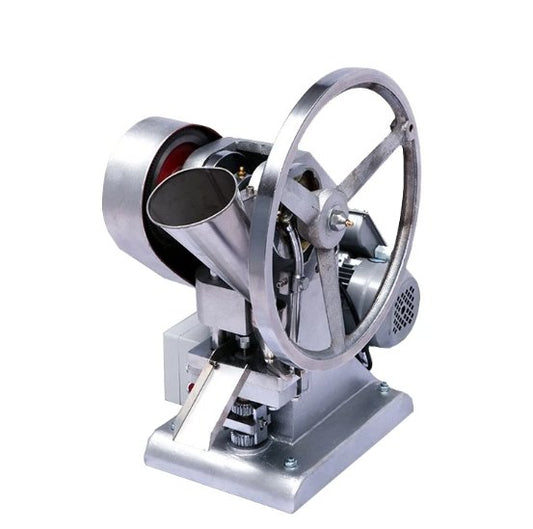
Collection: Single Punch Tablet Press (Lab & R&D Tablet Machine)
About Single Punch Tablet Press (Lab & R&D Tablet Machine)
A single punch tablet press compresses powder into tablets one at a time using a single die and punch set, making it the standard machine for pharmaceutical, nutraceutical and chemical R&D. It is ideal for formulation screening, pilot batches and small-scale specialty production where minimal material waste and precise control matter more than output. Operation is simple, quiet and low-cost compared with high-speed rotary presses.
How to Choose
- Output requirement - choose a single punch press for R&D and small batches, not for commercial-scale volume.
- Tooling and tablet size - confirm die and punch compatibility for your target tablet diameter, shape and thickness.
- Compression force - verify the maximum force covers your formulation's hardness needs.
- Material and cleanability - look for stainless contact parts and easy disassembly for quick cleaning between trials.
- Manual versus servo or automatic - decide based on batch size, repeatability and operator skill.
Model Selection Guide
The models below are real CECLE products in this series. Contact us or see doc.cecle.net for full specifications and a quote.
| Model |
Description |
| TDP |
The TDP series single punch tablet press is a compact, highly efficient mechanical device engineered for pressing granular and powdered materials into precise tablets. |
FAQ
Q: What is a single punch tablet press used for?
A: It is mainly used in laboratories and pilot plants to develop formulations, test compressibility and produce small specialty batches with minimal powder waste.
Q: How is a single punch press different from a rotary tablet press?
A: A single punch press makes one tablet per cycle with simple, low-cost operation, while a rotary press uses a rotating turret for thousands of tablets per hour at industrial scale.
Q: Can a single punch press handle different tablet shapes?
A: Yes, by changing the punch and die set you can produce different diameters, shapes and embossing, which makes it flexible for formulation trials.
Q: What compression force do I need?
A: Required force depends on the powder and target hardness; single punch presses suit moderate forces for basic formulations, while difficult-to-compress blends may need a rotary press.