Collection: Industrial Cleaning Machine | Ultrasonic Parts Washer & Degreasing Equipment
About Industrial Cleaning Machine | Ultrasonic Parts Washer & Degreasing Equipment
An industrial cleaning machine covers ultrasonic cleaners, spray parts washers and degreasing systems used to remove oil, grease, dust and fine contaminants from parts. Ultrasonic cleaners use high-frequency sound waves in a heated cleaning tank to clean intricate components that are difficult to scrub by hand. Common users include workshops, repair shops, factories and maintenance teams cleaning engine parts, bearings, valves, fasteners and machined components. Frame your purchase around part size, contamination type and daily cleaning volume.
How to Choose
- Tank size — the cleaning bath must be larger than your largest part
- Ultrasonic frequency — lower frequencies for heavy degreasing, higher frequencies for delicate parts
- Power and heating — more ultrasonic power speeds up cleaning of larger solution volumes
- Construction material — corrosion-resistant stainless steel tanks for industrial cleaning agents
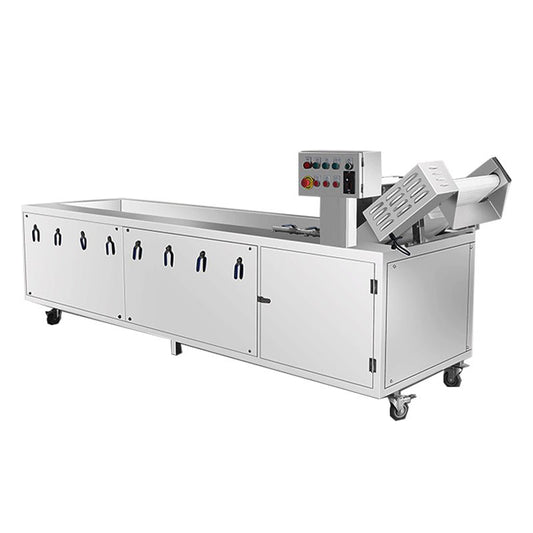
- Automation level — from single benchtop baths to multi-stage conveyor systems for continuous production
FAQ
Q: What is the difference between an ultrasonic cleaner and a spray parts washer?
A: An ultrasonic cleaner uses high-frequency vibration in a liquid bath to clean internal and blind-hole areas, while a spray washer blasts parts with high-pressure jets. Many operations use both in sequence for heavy contamination.
Q: How do I choose the right ultrasonic frequency?
A: Lower frequencies around 20 to 40 kHz give strong, abrasive cleaning for metal parts and heavy oil. Higher frequencies around 68 to 120 kHz clean delicate items such as precision parts more gently.
Q: What size cleaning machine do I need?
A: Choose a tank that fits your largest part with room for the solution to circulate. For continuous production, a conveyor or multi-stage system with automatic loading beats a single benchtop tank.
Q: What should I look for in build quality?
A: Check for welded 304 or 316 stainless steel tanks, quality transducers, overflow and drain ports, and heating elements rated for your cleaning cycle. Transducer quality largely determines service life.