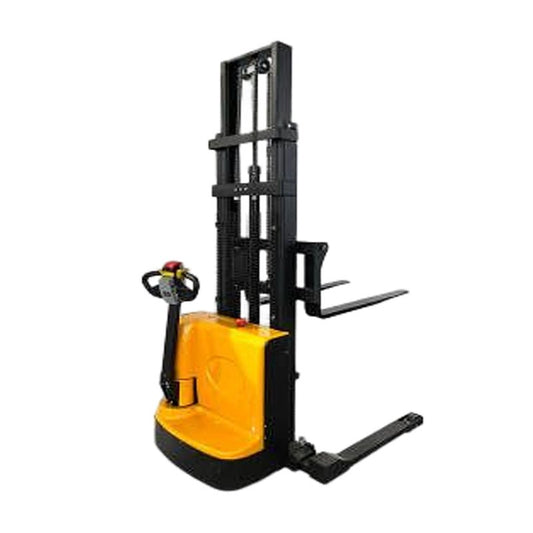
Collection: Electric Pallet Stacker & Powered Walkie Stacker
About Electric Pallet Stacker & Powered Walkie Stacker
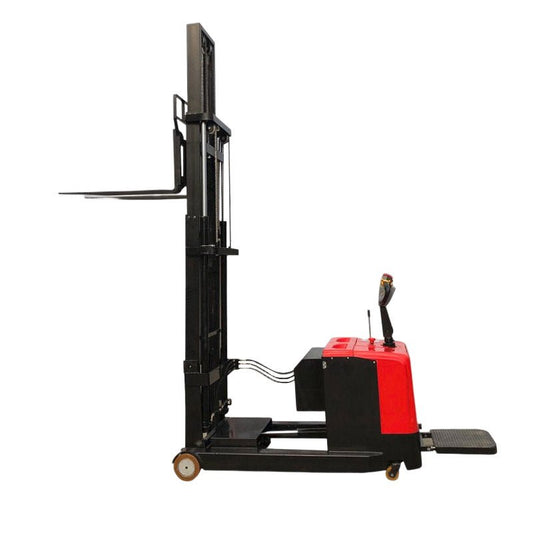
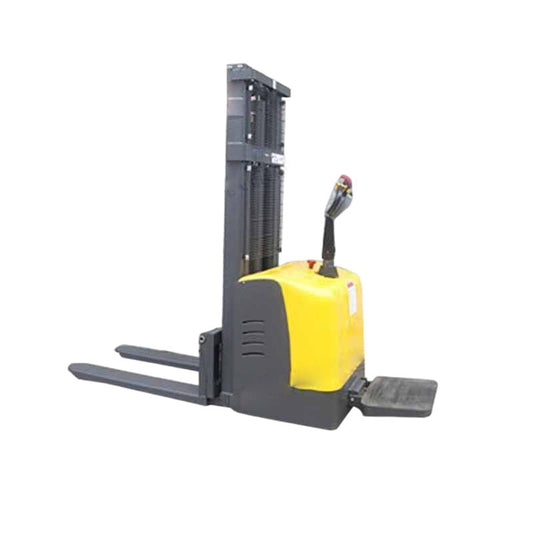
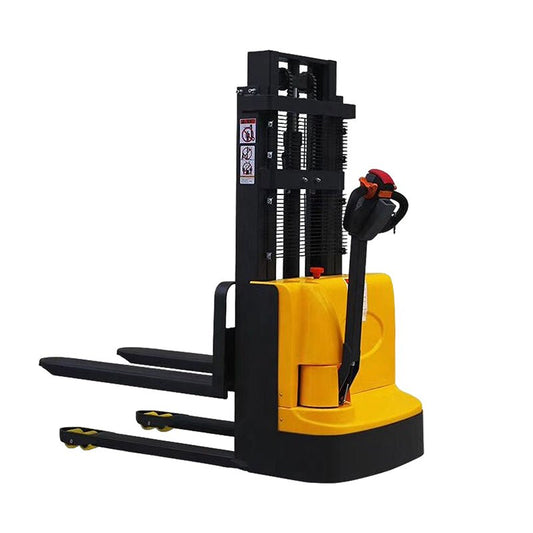
An electric pallet stacker, also called a walkie stacker or powered stacker, lifts pallets and positions them onto racking using a battery-powered lift, with an electric drive motor moving the machine while the operator walks alongside. It fills the gap between a manual pallet jack and a counterbalance forklift: more capable than ground-level handling, but smaller, cheaper and simpler to operate than a full forklift. Typical models carry around 1 to 2 tons and lift from about 1.6 m up to 5.5 m depending on the mast. They are widely used in small and mid-size warehouses, retail stockrooms, cold storage and manufacturing plants for stacking and retrieving pallets.
How to Choose
- Load capacity at your load center, noting that capacity drops at higher lift heights
- Maximum lift height matched to your racking plus clearance
- Mast type: simplex for low lift, duplex for standard racking, triplex full-free-lift for high or low-clearance buildings
- Battery type: lead-acid for single shifts, lithium-ion for fast charging and multi-shift work
- Aisle width and turning radius to fit your warehouse layout
FAQ
Q: What lift height do I need?
A: Measure your top racking beam, add the pallet height and about 150 to 200 mm of clearance. Common lift heights are 1600, 2500, 3000, 3500 and 4500 mm; choose the mast that covers your highest storage level.
Q: Which mast type should I choose?
A: A simplex mast is economical for low lift heights, a duplex telescopic mast suits standard racking up to around 3.5 m, and a triplex full-free-lift mast reaches high levels while keeping a compact collapsed height for low doorways.
Q: Lead-acid or lithium battery?
A: Lead-acid is lower cost and fine for one shift with overnight charging but needs watering and slow charging. Lithium-ion charges in a fraction of the time, needs no maintenance and suits multi-shift or cold-storage operations.
Q: Why does capacity change with lift height?
A: Rated capacity is quoted at a standard load center and at ground level. As the forks rise, stability decreases, so the safe load falls. Always check the capacity chart at your actual stacking height before committing to a model.