

packaging machine
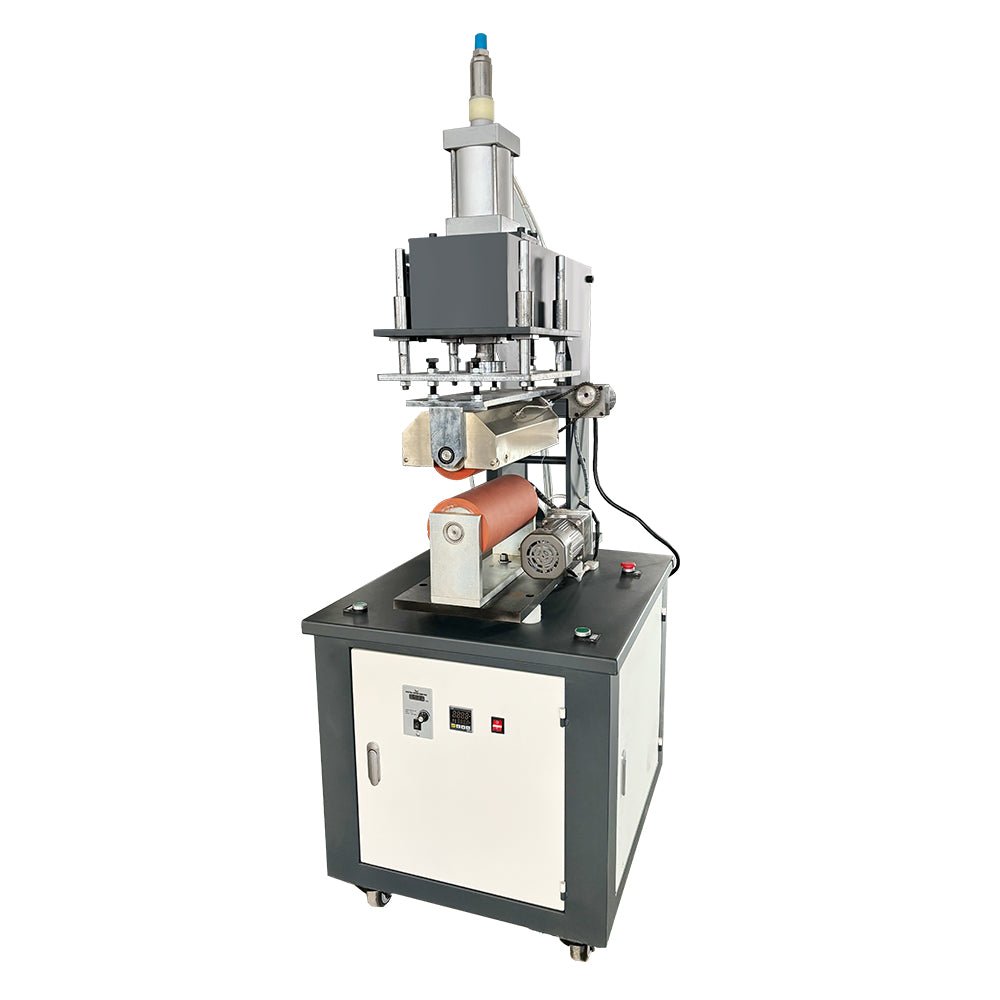
HT-RB-300 Heat Transfer Machine for Skateboard (Pneumatic Roller)
HT-RB-300 Heat Transfer Machine for Skateboard (Pneumatic Roller)
Couldn't load pickup availability
CECLE HT-RB-300 vs. Traditional Heat Transfer
| Aspect | CECLE HT-RB-300 (This Machine) | Traditional / Generic Alternative |
|---|---|---|
| Operational mechanism | Pneumatic drive delivers consistent 0.6T transfer pressure via an external air compressor | Manual lever or low-pressure platen with uneven, operator-dependent pressure |
| Edge & curve quality | 45° Shore A silicone roller conforms to concave skateboard contours — bubble-free, wrinkle-free edges | Flat platen cannot follow curves; air bubbles and edge lift are common |
| Defect / pain points solved | Eliminates edge-transfer failure on double-kick decks, longboards and cruiser boards | High scrap rate on curved substrates; frequent rework |
| Efficiency | 2–5 pcs/min with adjustable speed control and uniform heat distribution | Slower, inconsistent output limited by manual force |
| Stability & maintenance | 230 kg low-center-of-gravity frame stays rock-steady at 0.6T; roller spins during cooldown to avoid flat spots | Light frames shift under pressure; rollers deform if stopped hot |
Technical Specifications
| Specification | Value & Unit |
|---|---|
| Roller Hardness | 45° (Shore A) |
| Heating Transfer Size | 250 × 300mm (9.8 × 11.8 in) |
| Transfer Pressure | 0.6T |
| Device Power | 3 kW |
| Printing Speed | 2 ~ 5 pcs/min |
| Input Voltage | 220V/380V 50~60Hz |
| Air Pressure Requirement | 0.6 ~ 0.8Mpa |
| Temperature Range | 0 ~ 400℃ |
| Machine Dimensions | 1780 × 730 × 670mm (70.1 × 28.7 × 26.4 in) |
| Machine Weight | 230KG (507.1 lb) |
Pre-installation requirements: Device Power: 3 kW; Input Voltage: 220V/380V 50~60Hz; Air Pressure Requirement: 0.6 ~ 0.8Mpa; Machine Dimensions: 1780 × 730 × 670mm (70.1 × 28.7 × 26.4 in); Machine Weight: 230KG (507.1 lb). External air compressor (3 HP / 2.2 kW or above) required.
Compatible Applications & Materials
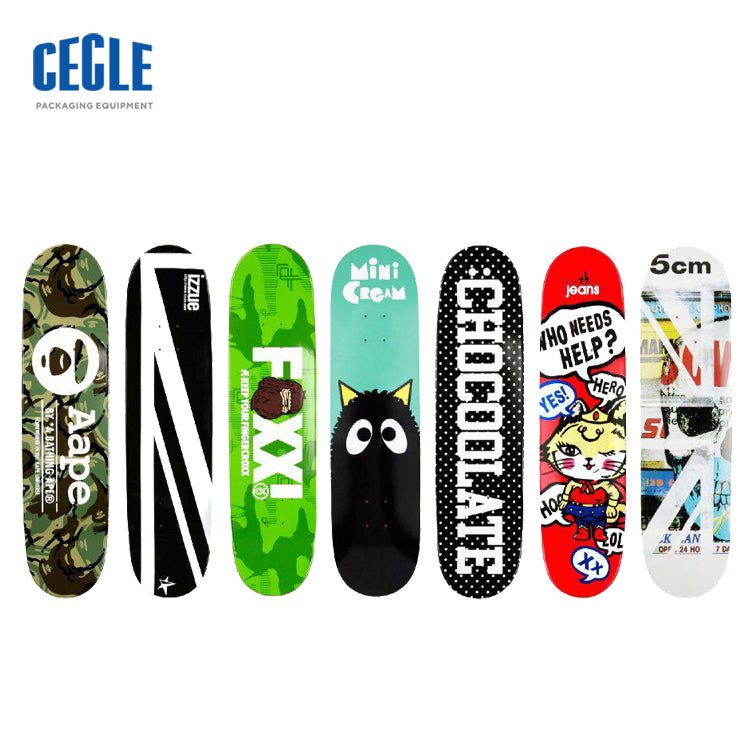
Machine Demo Video: HT-RB-300 Skateboard Heat Transfer Machine Operation Demo Core Components: 45° Heating Silicone Roller (Heating Rubber), Motor Drive System, Temperature Control Panel. Finished Samples: Visual samples demonstrating high-definition transfer results on professional double-kick decks, longboards, and cruiser/penny boards.
Standard Operating Procedure (SOP)
- Air Supply Connection: Connect the air compressor hose and adjust the pressure to the standard working range of 0.6–0.8Mpa
- Power Up: Turn on the main Power Switch, and the dashboard display will light up
- Speed Control: Turn on and adjust the Speed Controller to ensure the silicone roller starts rotating for uniform heat distribution
- Temperature Preset: Set the required transfer temperature on the thermostat and wait for the heating roller to reach the target value
- Execute Transfer: Manually place the skateboard deck and the transfer film
- Once aligned, press the dual Operate Buttons simultaneously
- Safety Monitoring: In case of any abnormality during operation, immediately hit the red Emergency Stop button
Engineering FAQ
Is the 230kg weight stable enough under high-pressure operations?
A: Absolutely. The 230kg weight is scientifically optimized. With a low and evenly distributed center of gravity, the machine remains rock-steady without any vibration or shifting, even under 0.6T of pressure.
Why does the silicone roller need to keep spinning after turning off the heat?
A: If the silicone roller stops spinning while still at a high temperature, gravity and localized residual heat will cause permanent flat spots or deformation. Keeping it rotating during the cooling phase greatly extends the lifespan of the 45° silicone roller.
Why is the 45° Shore A silicone roller specified for the HT-RB-300?
A: The 45° hardness gives the ideal cushioning and resilience to conform to the concave contours and edge curvatures of a skateboard deck, ensuring seamless transfer without air bubbles or wrinkles — the core pain point of curved-substrate heat transfer.
What air compressor is strictly required for this machine?
A: The machine is pneumatically driven and requires an external air compressor. CECLE recommends a 3 HP (2.2 kW) or larger unit to hold stable 0.6–0.8 MPa output during continuous operation.
Why must the roller keep spinning after the heat is turned off?
A: If the silicone roller stops while still hot, gravity and residual heat create permanent flat spots or deformation. Keeping it rotating for ~30 minutes during cooldown extends roller life significantly.
How does the machine handle different deck sizes and shapes?
A: The manual placement + alignment workflow and adjustable pressure/speed suit double-kick decks, longboards and cruiser boards; tooling or film jigs can be adapted per deck dimensions.
Full Documentation & Drawings
Complete technical manual, parameters and engineering drawings: CECLE Docs — HT-RB-300
Related CECLE Machines
Request a Quote
Send your deck size, transfer film and target output to CECLE for a tailored configuration, lead time and factory-direct quotation.
Share