

CECLE Machine
OV-1/2/3 Pizza Deck Oven for Bakeries & Pizzerias
OV-1/2/3 Pizza Deck Oven for Bakeries & Pizzerias
Couldn't load pickup availability
CECLE OV-1/2/3 vs. Traditional / Generic Alternative
Where the CECLE OV-1/2/3 stands out against manual or generic pizza deck oven — measured on the dimensions buyers care about most.
Technical Specifications
| Food Category | Recommended Top / Bottom Heat | Baking Time | Baking Gear & Setup | Target Result & Chef Tips |
|---|---|---|---|---|
| Thin-Crust Italian Pizza | Top 230°–250°C / Bottom 250°–280°C | 7–10 mins | Perforated pizza pan or Cordierite stone | Crispy leopard-spotted base, melted caramelized cheese |
| Chiffon Cake (8″ / 10″) | Top 150°–160°C / Bottom 150°–160°C | 45–55 mins | Anodized aluminum round cake molds | Uniform slow rise without cracking; no shrinkage on cooling |
| Sandwich Loaf Toast (450g) | Top 190°–200°C / Bottom 200°–210°C | 30–35 mins | Standard corrugated lidded toast tins | Square, even golden crust with soft shredded crumb structure |
| Portuguese Egg Tarts | Top 210°–220°C / Bottom 190°–200°C | 20–25 mins | Standard 400 × 600 mm baking sheet | Flaky layered pastry with caramelized brûlée custard spots |
| Cantonese Mooncakes | Top 200°–210°C / Bottom 170°–180°C | 18–22 mins | Flat non-stick baking sheet (egg washed) | Crisp, defined pattern contours without collapsing or dome |
| Roasted Whole Chicken / Ribs | Top 200°–220°C / Bottom 190°–200°C | 35–45 mins | Deep stainless pan with wire fat rack | Penetrating core heat renders juices; glossy, crisp skin |
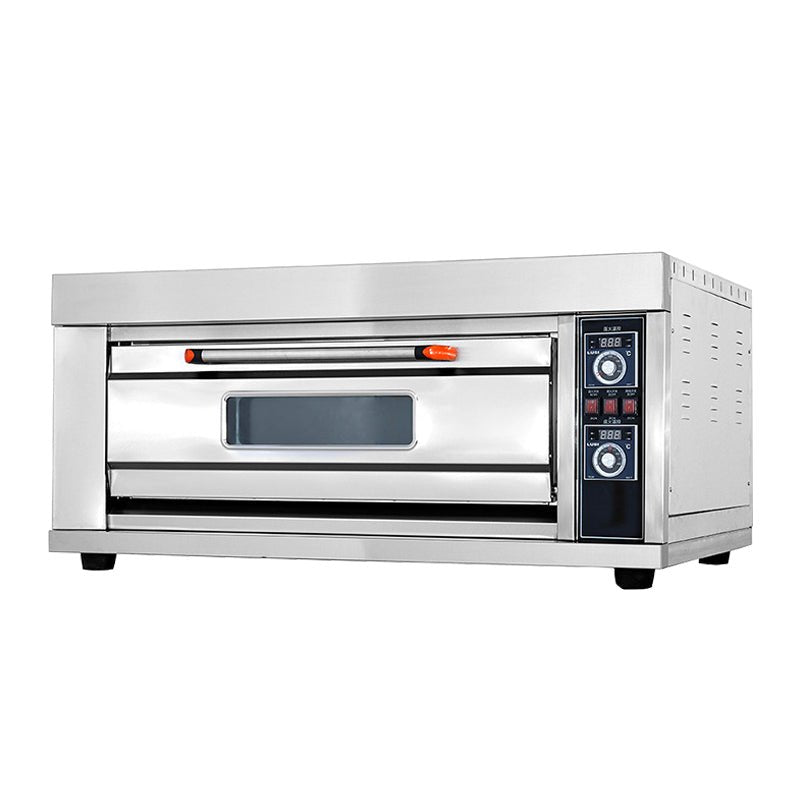
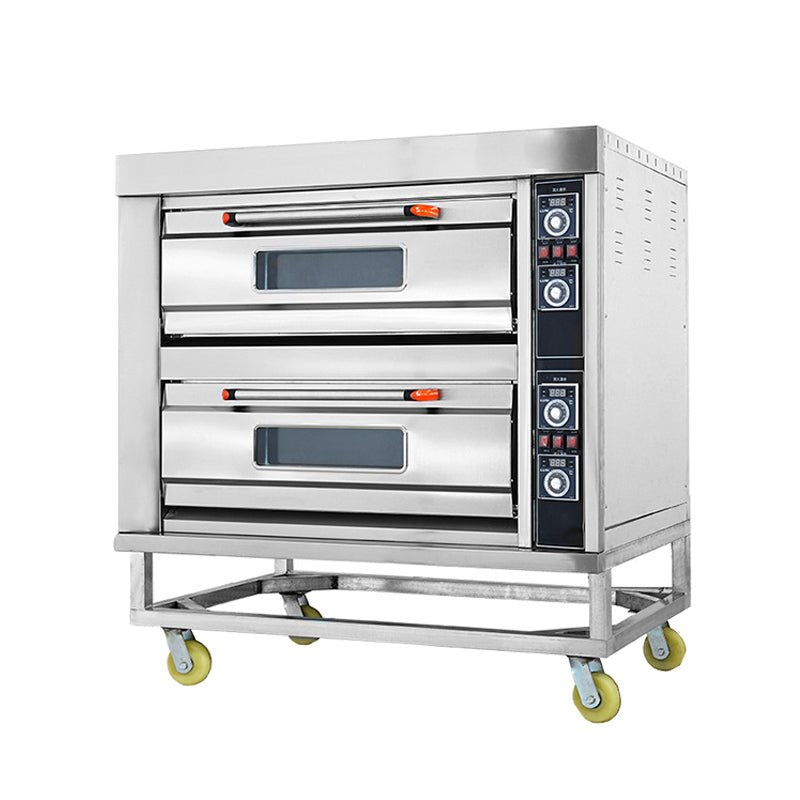
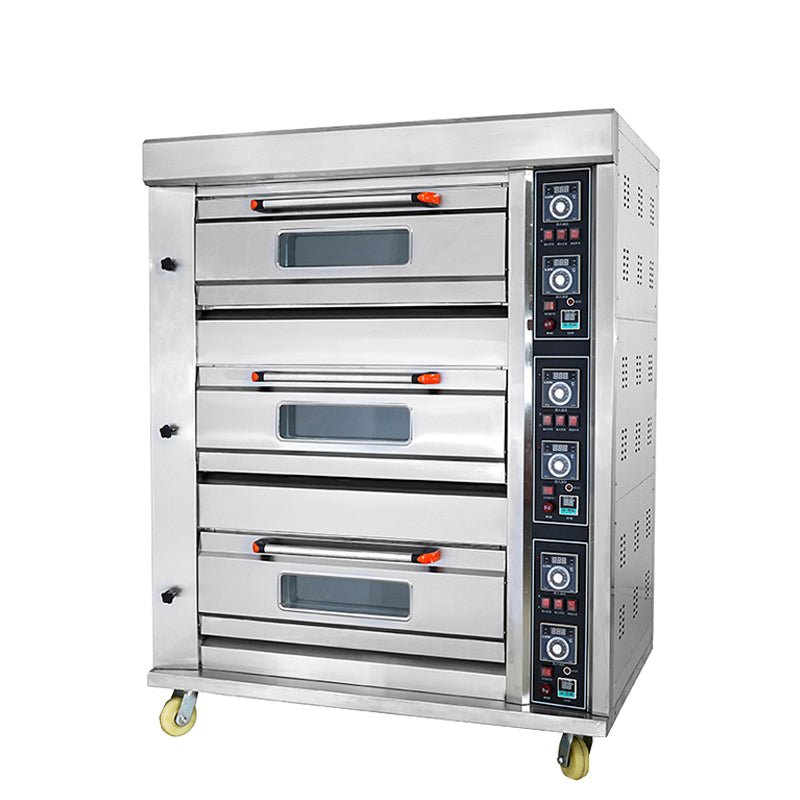
| Technical Parameters | OVE-01 (1-Deck 2-Tray Standard) | OVE-02 (2-Deck 4-Tray Efficiency) | OVE-03 (3-Deck 6-Tray High-Capacity) |
|---|---|---|---|
| Baking Decks & Capacity | 1 Deck (Fits 2 Trays) | 2 Decks (Fits 4 Trays) | 3 Decks (Fits 6 Trays) |
| Baking Sheet Standard | 400 × 600 mm (16″ × 24″ Commercial) | 400 × 600 mm (16″ × 24″ Commercial) | 400 × 600 mm (16″ × 24″ Commercial) |
| Rated Heating Power | 6.6 kW (~8.8 HP) | 13.2 kW (~17.7 HP) | 19.8 kW (~26.55 HP) |
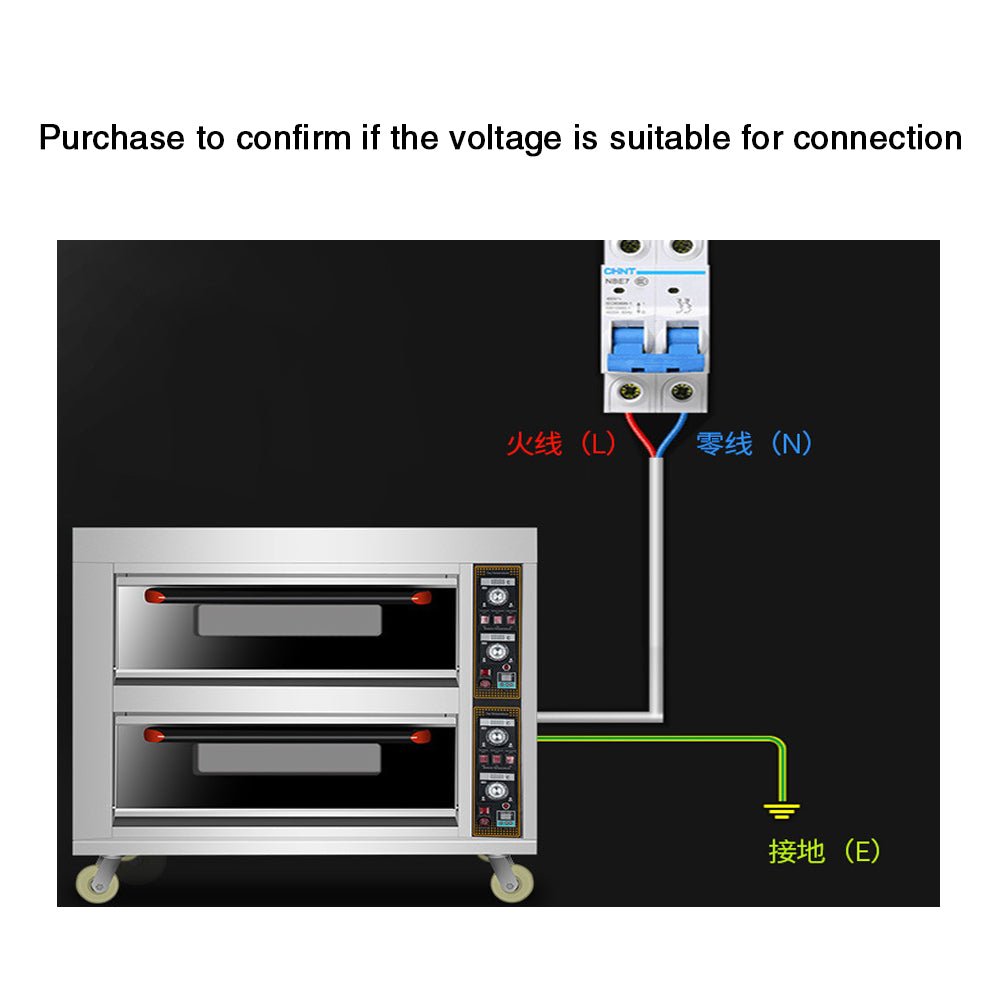
| Rated Voltage | 220V 1-Phase / 380V 3-Phase (50/60Hz) | 380V 3-Phase (50/60Hz) | 380V 3-Phase (50/60Hz) |
| Temperature Range | Ambient to 300°C (Dual Zone) | Ambient to 300°C (Per Deck Indep.) | Ambient to 300°C (Per Deck Indep.) |
| Timer Range | 0–99 Min Independent Timer with Alarm | 0–99 Min Independent Timer with Alarm | 0–99 Min Independent Timer with Alarm |
| Chamber Size (L×W×H) | 870 × 630 × 230 mm (34″×25″×9″) | 870 × 630 × 230 mm (Per Chamber) | 870 × 630 × 230 mm (Per Chamber) |
| Overall Size (L×W×H) | 1250 × 820 × 570 mm (49″×32″×22″) | 1250 × 820 × 1300 mm (49″×32″×53″) | 1250 × 820 × 1450 mm (49″×32″×57″) |
| Chassis & Deck Materials | Brushed Stainless Exterior + Alum Deck | Brushed Stainless Exterior + Alum Deck | Brushed Stainless Exterior + Alum Deck |
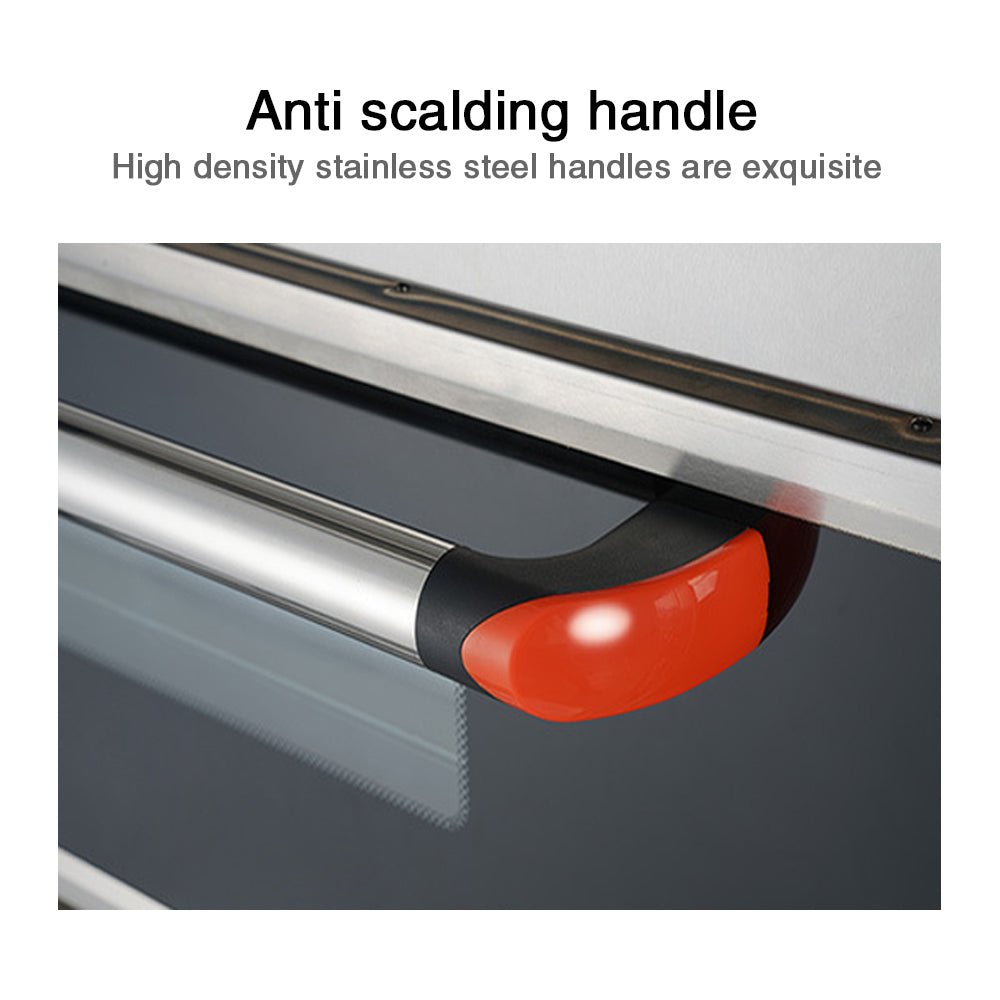
| Door Construction | Double Tempered Glass + Insulated Grip | Double Tempered Glass + Insulated Grip | Double Tempered Glass + Insulated Grip |
| Recommended Venue | Coffee bars, small pizzerias, studios | Mid-sized bakeries, bistros, tea cafes | Central bakery plants, hotel banquets |
Compatible Applications & Materials
- industrial products — primary target products for this Pizza Deck Oven line
- Standard industrial materials compatible with the machine's rated spec range
- B2B production lines and contract manufacturing workshops
Standard Operating Procedure (SOP)
- Setup: connect the required power / air supply and verify the control display.
- Parameter preset: set speed / temperature / pressure per the product spec.
- Material loading: place the product in the correct fixture / mold slot.
- Execution: start the cycle; monitor for stable, repeatable output.
- Quality check: inspect the first units; adjust if deviation appears.
- Safety & cooldown: use Emergency Stop on abnormality; allow cooldown before maintenance.
Engineering FAQ
How do I choose between OVE-01 (1-deck), OVE-02 (2-deck), and OVE-03 (3-deck)?
A: Your decision depends on available electrical supply, floor space, and peak production volume : Choose OVE-01 (1-Deck 2-Tray) : Best for compact cafes, specialty pizza shops, or boutique pastry studios running single-recipe menus and standard 220V single-phase electrical supply; Choose OVE-02 (2-Deck 4-Tray) : The industry sweet spot for artisan bakeries and busy bistros, enabling simultaneous multi-temperature baking (e.g., bread on one deck, cookies on another) for venues serving 100–300 customers daily; Choose OVE-03 (3-Deck 6-Tray) : Essential for wholesale production bakeries and central kitchens requiring vertical space efficiency and massive simultaneous tray output.
Can this deck oven bake authentic Italian thin-crust (Neapolitan) pizza directly?
A: Yes, absolutely. With a chamber depth of 630 mm and width of 870 mm, it accommodates multiple 10″ to 12″ pizza screens. By placing optional commercial cordierite pizza baking stones directly on the deck and setting the bottom heat between 280°C and 300°C, the stone delivers intense conductive heat to produce an authentic crispy crust with characteristic leopard-spot char in 5–8 minutes.
What should I do if baking coloration is slightly uneven between the front and back?
A: While heating tube geometry is optimized for even distribution, opening the door naturally introduces minor temperature differences near the entrance. To ensure perfection: Leave a 3–5 cm gap between adjacent trays for convective air movement rather than jamming them against the chamber walls; For delicate items like chiffon cakes or macarons, rotate the baking trays 180° once the dough has set (around 60% through the baking cycle).
What routine maintenance keeps the OV-1/2/3 stable for long production runs?
A: Keep the working area clean, verify the rated power/air supply before each shift, and inspect wear parts per the technical manual. Stable input conditions are the main factor in consistent output and long service life.
Which product sizes and formats can the OV-1/2/3 handle?
A: The machine is configured for its rated specification range (see Technical Specifications). For formats outside the standard range, CECLE can advise on tooling or model selection.
Full Documentation & Drawings
Complete technical manual, parameters and engineering drawings: CECLE Docs — OV-1/2/3
Related CECLE Machines
Request a Quote
Send your product specifications, target output and format details to CECLE for a tailored configuration, lead time and factory-direct quotation.
Share